For the first time in the Republic of Moldova, the Network of Local Ambassadors for European Integration has been established, an initiative aimed at supporting local public authorities in strengthening the competencies required to transpose European requirements into community administration and align public services with European Union standards, ensuring transparent and efficient local governance.
The Network is launched by the Congress of Local Authorities from Moldova (CALM), in partnership with the Moldovan-Swedish PACE Local Project, implemented by SALAR International with the support of the Government of Sweden through Sida, as part of efforts to support the European path of the Republic of Moldova and the active integration of local authorities’ contribution into this complex process.
As the Republic of Moldova advances on its European integration path, the involvement of local public authorities is becoming increasingly important for the implementation of European standards at the local level, given that up to 70% of the European Union acquis has a direct impact on the activities of local administrations. In this context, it is essential that local public authorities are well informed, trained, and prepared to put these requirements into practice.
The Network of Local Ambassadors for European Integration will facilitate knowledge transfer and a better understanding of the European integration process, support the training of local authorities for the implementation of the EU legislative framework, encourage the involvement and support of citizens in the process of aligning communities with European practices, and strengthen cooperation among local authorities, with the aim of extending the impact of European integration to all localities, regardless of their size or region.
The Network will bring together both local elected representatives—mayors and deputy mayors—as well as public officials. The political component, consisting of mayors and deputy mayors, will provide leadership, vision, and advocacy to ensure that the role and interests of local authorities are adequately reflected in national and European discussions on reforms related to European integration. The technical component, consisting of municipal employees, will contribute to strengthening the institutional and professional capacities of local administrations, supporting the understanding, implementation, and monitoring of European Union standards and programmes.
Maria Tropp, Head of Development Cooperation at the Embassy of Sweden in the Republic of Moldova, underlined that, as Moldova advances in the European integration process, local public administration plays an essential role in transforming European policies and standards into tangible benefits for communities. To achieve real progress, capacity building, as well as the continuous exchange of information and experience, are necessary, and this is the mission of the Network of Local Ambassadors for European Integration.
Present at the launch event of the Network of Local Ambassadors for European Integration, Marcel Spatari, Chair of the Parliament’s Commission for European Integration, stated that national authorities rely on the active involvement of local public authorities in the process of consulting draft laws aimed at transposing the EU acquis. At the same time, the Member of Parliament noted that the Network of Local Ambassadors can make a proactive contribution to discussions on future reforms that are to be launched. “This network must help us strengthen ourselves as a society around the common objective of European integration,” emphasized Marcel Spatari.
Rodica Crudu, Deputy Secretary General of the Government, welcomed the establishment of the Network of Local Ambassadors for European Integration, noting that this model has been successfully implemented in several EU Member States, where it has contributed to accelerating national-level transformations for the direct benefit of citizens. “We hope that this network will facilitate the strengthening of links between central and local authorities, as well as with other stakeholders involved in the EU accession process. At the same time, the network should contribute to the transfer of European best practices to communities in order to ensure efficient public services and high standards of living,” stated Rodica Crudu.
For his part, Viorel Furdui, Executive Director of CALM, explained that the role of local public authorities is crucial in the European integration process, primarily because they are the closest to citizens, but also because a significant part of the European legislative framework has a direct impact on the activities of local public administration.
To support local authorities on their European path, members of the Network will benefit from Swedish and other EU Member States’ expertise, training programmes, exchanges of experience with countries that have already gone through the integration process, mentoring, and assistance in making use of the opportunities offered by the European Union to local public authorities.
In the first phase, local authorities were informed about the concept and operating principles of the Network. At the beginning of 2026, CALM, with the support of the PACE Local Project, will launch the first call for the selection of Local Ambassadors for European Integration, with the Network to be subsequently expanded through the involvement of active and committed individuals willing to contribute to the European integration efforts of the Republic of Moldova.

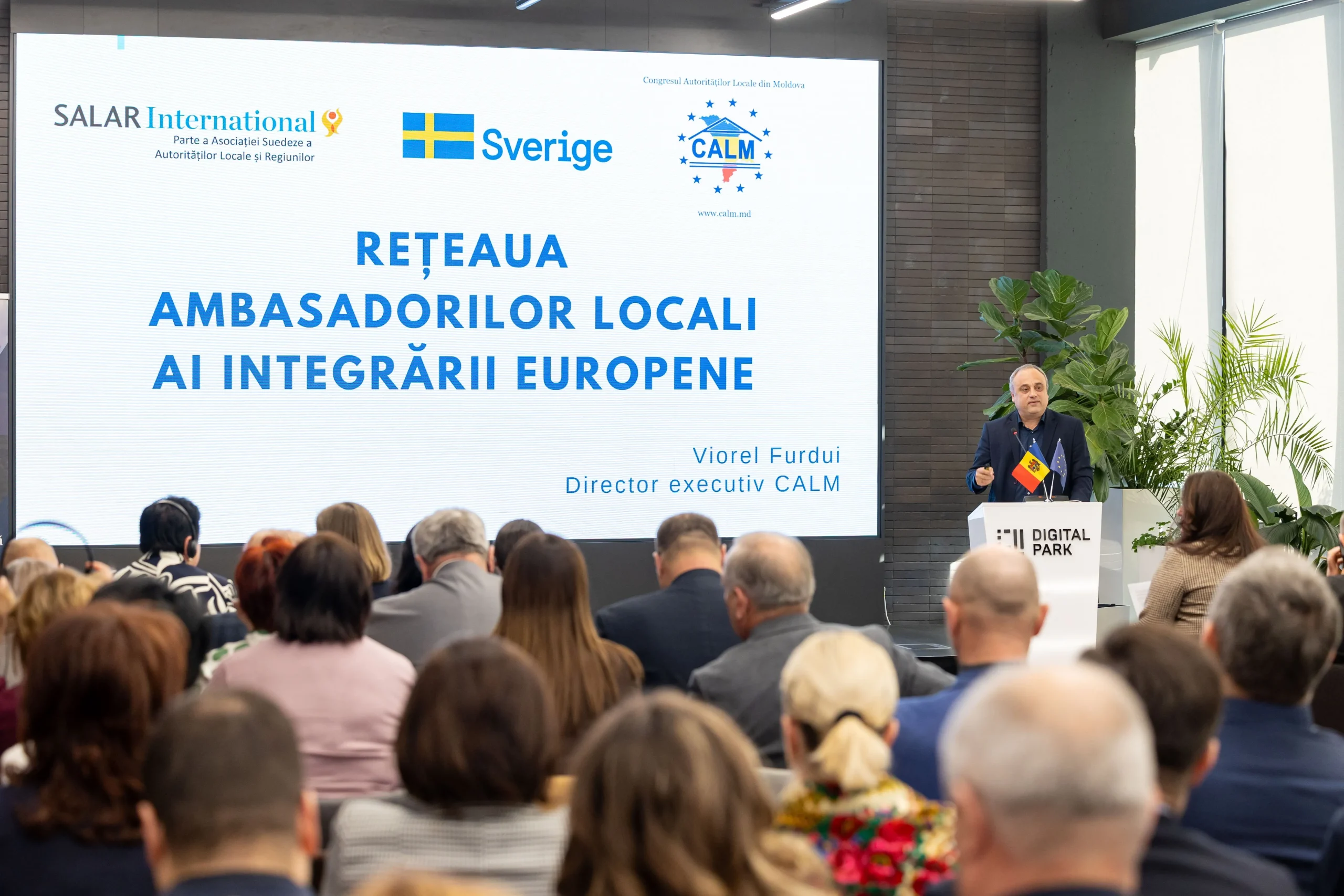
The network of Local Ambassadors for European Integration – a premier for the Republic of Moldova to support local authorities in the european integration process
Photo Gallery